Experience Design
Family Safari Lodges
Where children are expected, not merely allowed.

By Hans Arnesen, Founder of Reverie Safaris · Updated September 2026
The Best Safari Lodges for Families and Multi-Generational Groups
Where children are expected, not merely allowed.
Any lodge that takes children has the photographs: a child mid-cannonball into the pool, a long table under a fig tree laid for three generations. What the pictures leave out is filed in the child policy and the small print beneath the rates, and it shapes the trip more than any view. Six is the usual minimum age for a shared game drive, so a lodge can welcome a four-year-old warmly and still leave her at camp while the others go out to see what the whole family crossed an ocean for.
We begin where the photographs stop. Three facts matter more to a family than any lodge's fame: the youngest age allowed on a game drive; whether anyone will need antimalarials, which can choose the country for you; and who pays for the private vehicle that so often makes the age rule negotiable. Overlook them and even a celebrated lodge, photographs and all, becomes an expensive place to wait.
For how to shape the whole journey around a family, start with Luxury Family Safaris. For the case for taking a whole house, see our Private Safari Villas.

The Short Answer
The best safari lodges for families let the youngest traveler join the game drive, in a private vehicle if need be. They sit in malaria-free country or make the malaria conversation easier. And they give three generations room to be together without living on top of one another.
For young children, the lead belongs to South African reserves where CDC advises no antimalarials: Kwandwe, Morukuru Family and Marataba for the Big Five, and Tswalu Kalahari, which has no elephants but includes a private vehicle with every booking. In East Africa, Cottar's 1920s Camp in Kenya and Singita Grumeti in Tanzania pair all-ages policies with real children's programs. For school-age children, Londolozi's Cubs Den sets the standard in the Sabi Sand. For a whole-family buyout, Singita Malilangwe House in Zimbabwe, or Sarili at Shamwari in the malaria-free Eastern Cape. Teenagers unlock more: walking safaris in the Okavango from twelve at Wilderness camps such as Vumbura Plains, and gorilla trekking from fifteen.

Three Decisions Before the Lodge
The Youngest Traveler
Age rules on safari look arbitrary until you read enough of them, and then a ladder appears. The first rung is six, the most common minimum for a shared game drive, and below it most properties require a private vehicle or a house of your own. Higher up, walking safaris generally start between twelve and sixteen depending on the reserve, and mountain gorilla trekking at fifteen. The practical rule follows: plan around the youngest traveler, because the youngest traveler decides which lodges are possible at all.
Malaria
"Malaria-free" is used loosely in safari marketing, so precision helps. The Kalahari, Madikwe and the Eastern Cape sit outside all of CDC's South African risk areas. What keeps them clear is climate, not spraying. Malaria travels with Anopheles mosquitoes, which breed in standing water and need sustained warmth for the parasite to develop inside them, so transmission fades with altitude, in dry country and wherever winters turn cold. Malaria-free is not mosquito-free, though, so repellent still earns its place in the bag. The Waterberg, home to Marataba and Welgevonden, is a strong option too: CDC rates the area low-risk and recommends no antimalarials, only bite precautions. The risk areas themselves are specific: the Mopani and Vhembe districts of Limpopo, Ehlanzeni in Mpumalanga, uMkhanyakude in KwaZulu-Natal, and Kruger National Park. In each of them, CDC advises antimalarial prophylaxis year-round, while South Africa's health department recommends it from September to May, so a family traveling in July may hear two answers. East Africa is simpler: in Kenya, CDC's malaria zone covers everywhere below 2,500 meters, game parks included. Your physician makes the medical call. The right lodge makes it an easier conversation.
The Private Vehicle
A private vehicle is what turns a four-hour game drive into a ninety-minute one when a small child has had enough, and it is the largest hidden variable in a family safari quote. Some properties include one with every booking, as Tswalu does. Some include it by room type: at Singita Ebony, families of four or more with a child under ten book a family suite and receive a private vehicle at no charge, while families of three pay for one. Some require it: Angama Mara asks families with children six and under to reserve one when they book fewer than three suites. Exclusive-use houses settle the question, because the vehicle comes with the house. When a house becomes better value than separate suites is covered in How Much Does a Luxury Safari Cost?

The Ten at a Glance
The list opens with the reserves where no antimalarials are advised, Big Five first, moves on to lodges that make malarial country work for a family, and ends with a single house in Zimbabwe. Read the numbers as a map rather than a verdict.
1. Kwandwe Ecca Lodge and villas, South Africa. All ages in the private vehicle suites and villas · No malaria · Private vehicle with those suites and the villas · For three generations: Uplands Homestead, Melton Manor or Fort House
2. Morukuru Family, South Africa. All ages · No malaria · Private vehicle with every house · For three generations: Farm House, or two houses together
3. Shamwari Riverdene and Sarili, South Africa. All ages to stay; game drives from three · No malaria · Private vehicle with every Riverdene family room and with Sarili · For three generations: Sarili or a Riverdene three-bedroom room
4. Marataba Safari Lodge and Villa, South Africa. All ages at Safari Lodge and the Villa · Very low malaria risk; antimalarials not advised · Private vehicle with the Villa, at extra cost at Safari Lodge · For three generations: Marataba Villa
5. Tswalu Kalahari, South Africa. All ages · No malaria · No elephants, so no Big Five · Private vehicle with every booking · For three generations: Tarkuni or a Loapi home
6. &Beyond Phinda, South Africa. All ages; under-sixes drive only in a private vehicle · Antimalarials advised · Private vehicle with Mountain Lodge's family suite and cottages · For three generations: Phinda Homestead
7. Cottar's 1920s Camp, Kenya. All ages · Antimalarials advised · Private vehicle with the family tents and Bush Villa · For three generations: the Bush Villa
8. Singita Grumeti, Tanzania. All ages at most lodges · Antimalarials advised · Private vehicle free for families of four or more with a child under ten · For three generations: Serengeti House or Milele
9. Londolozi, South Africa. Six and up · Antimalarials advised · Private vehicle advised for families · For three generations: Pioneer Camp, booked whole
10. Singita Malilangwe House, Zimbabwe. All ages · Antimalarials advised · Private vehicle included · For three generations: the house itself

South Africa Without Antimalarials
For families with small children, geography does half the planning. CDC advises no antimalarials at any of these five, and all but Tswalu hold the Big Five.

1. Kwandwe Ecca Lodge and Villas, Eastern Cape, South Africa
Children: all ages in Ecca's private vehicle suites and the villas, on game drives too · Malaria: none · Private vehicle: with those suites and the villas · For three generations: Uplands Homestead, Melton Manor or Fort House
Kwandwe is our first answer for the family that wants the Big Five without the malaria conversation. The reserve was farmland before it was restored to wilderness, and Ecca is its family lodge. Three of Ecca's six suites are private vehicle suites for two adults and two children up to twelve, each with its own guide and vehicle, and childminding is free. Children under twelve don't ride on shared vehicles, so these suites are the family booking. The lodge is fully fenced, and a family program of scavenger hunts, sand art, eco board games, plaster casts of animal tracks and catch-and-release fishing keeps children busy between drives. Ask for nets on the plunge pools, a detail you only appreciate after a vacation spent watching a toddler near water.
For larger groups, Uplands Homestead sleeps six, Melton Manor eight, and Fort House four adults and four children, each with room for an infant. The Eastern Cape pairs naturally with Cape Town and the Garden Route, which is why it anchors so many first family safaris.
Great Fish River Lodge, Kwandwe's flagship, takes children only from twelve, and at the full adult rate, so the family booking is Ecca or a villa.

2. Morukuru Family, Madikwe, South Africa
Children: all ages, on game drives too · Malaria: none · Private vehicle: with every house · For three generations: Farm House, or Owner's House and River House together
Morukuru, a Relais & Châteaux property, takes the villa logic to its conclusion. There is no lodge, only three exclusive-use houses on a private concession in Madikwe's southeast corner, with two, three and five bedrooms, each fenced, solar-powered and fully staffed with its own guide, tracker, chef and vehicle. Children of every age join the game drives, and nothing runs to a timetable. Owner's House and River House sit side by side on the Marico River, linked by a wooden walkway, so two branches of a family can keep their own houses and still share dinner.
The texture is freedom rather than programming: fishing in the Marico, bush meals, a sleep-out. Adults can walk among the Big Five, while under-sixteens walk with a guide inside a fenced area. Stays of four nights or more can add the Safaris with a Purpose package, which brings a visit to the local school, a talk with one of Madikwe's researchers and a hand in conservation work such as rhino notching. The package is priced separately and booked at least a month ahead.
There is no children's club, and some families will miss one. Farm House sits on the far side of a mountain, fifteen minutes from the other two, and walkers sixty and over need a medical certificate, a detail worth settling before the grandparents arrive. More in our South Africa safari guide.
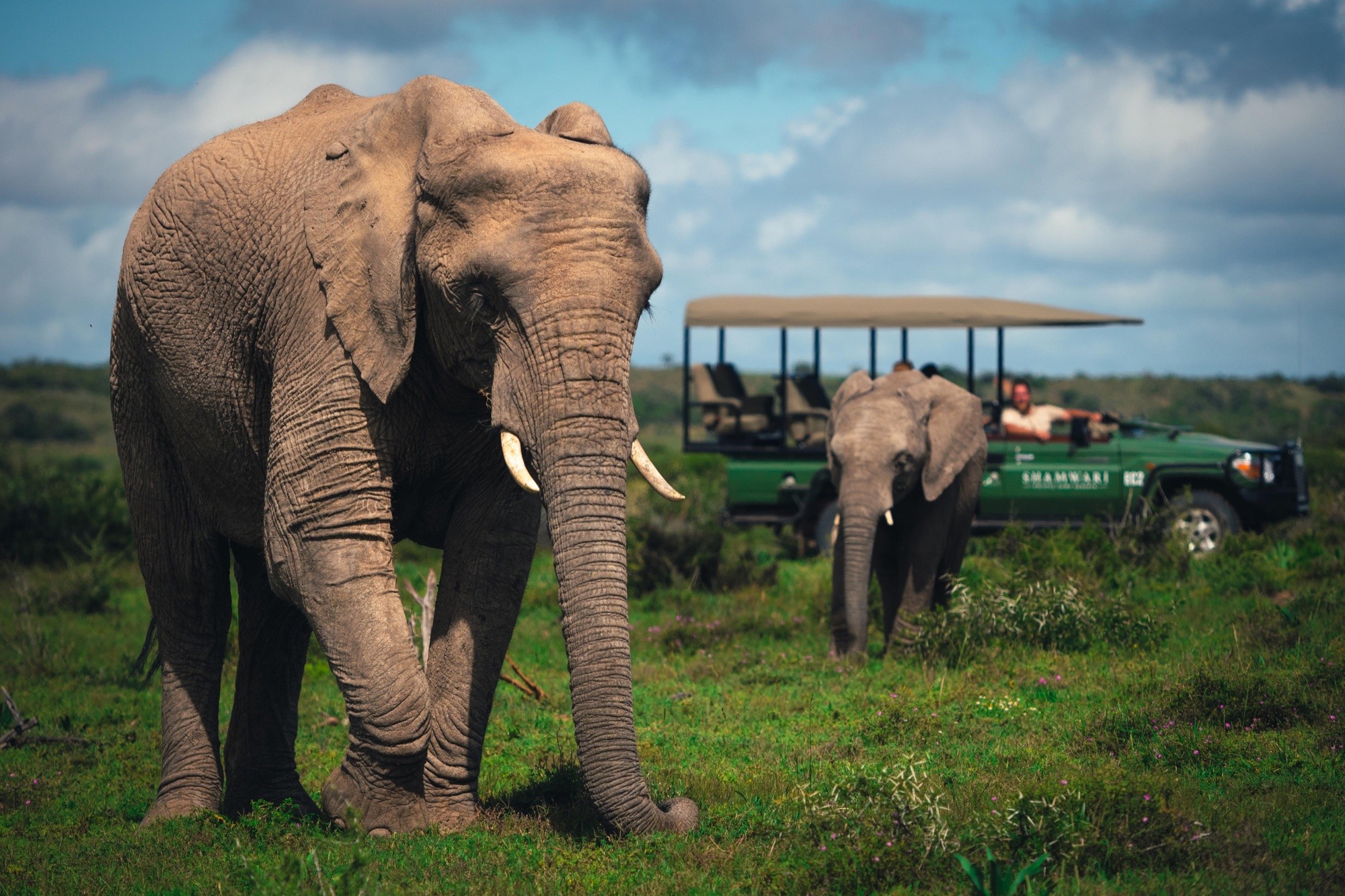
3. Shamwari Riverdene Family Lodge and Sarili Private Villa, Eastern Cape, South Africa
Children: all ages at Riverdene and Sarili; game drives from three · Malaria: none · Private vehicle: with every Riverdene family room and with Sarili · For three generations: Sarili, or Riverdene's three-bedroom family room
Shamwari is the second Eastern Cape reserve on this list, and the one with a whole lodge given over to children. Its roughly 61,800 acres of malaria-free Big Five country, where five of South Africa's nine biomes meet, lie under an hour's drive from Gqeberha, the city once called Port Elizabeth. The conservation work gives children something to see: Born Free has worked from the reserve since 1996 and runs two big cat sanctuaries with the Shamwari Foundation, and Shamwari's own wildlife rehabilitation center offers visits that are educational rather than hands-on.
Riverdene is the family lodge, and each of its four family rooms comes with its own safari vehicle: three have two bedrooms for four adults and two children, and one has three bedrooms for six adults and three children. The lodge is also home to the Kids Adventure Centre, at the heart of Shamwari's Kids on Safari program, with a zipline for older children, climbing walls, a network of treehouses, a maze and a children's library. For three generations, Sarili is a six-bedroom villa overlooking the Bushman's River, booked whole, for up to twelve guests, with its own vehicle, a butler and childminding on hand, a pool with a shallow area for children and a perimeter electric fence. Children staying there can be driven over to Riverdene for the adventure center.
Children under three wait at the lodge, even with a private vehicle, and the same age applies to visits to the Born Free sanctuaries and the rehabilitation center. Childminding is arranged before arrival and generally costs extra; Sarili's last published rates included it. For a child under three, Kwandwe's private vehicle suites and Marataba's Safari Lodge, which take any age on drives, have the edge. Long Lee Manor, the third lodge Shamwari lists for families, takes no child under six. Sarili is where our Family Safari itinerary ends.

4. Marataba Safari Lodge and Villa, Waterberg, South Africa
Children: all ages at Safari Lodge and the Villa, on game drives too; Mountain Lodge from sixteen · Malaria: very low-risk; CDC advises no antimalarials, only bite precautions · Private vehicle: with the Villa; at extra cost at Safari Lodge · For three generations: Marataba Villa, booked whole
Marataba brings the Big Five within a few hours of Johannesburg, and since June 2025 children of every age have joined the game drives at Safari Lodge. It is a privately managed section of Marakele National Park, within the UNESCO Waterberg Biosphere, and black rhino are its signature species. The road from Johannesburg takes three and a half to four hours; a 45-minute charter to Thabazimbi and an hour's transfer roughly halves it, which matters on a first safari with small children. And the Waterberg is very low-risk for malaria: CDC advises no antimalarials there, only bite precautions.
Families stay at Safari Lodge, where four of the fifteen tents are family tents for four, each pairing the parents' room with a children's bunk room that has its own bathroom. The Mack & Madi kids' club, included in the family-tent rate, runs spoor identification, cooking, picnics, movie nights and stargazing, and childminding can be arranged for outings a small child isn't ready for. Under-sixes stay free of the lodge rate, and six- to fifteen-year-olds pay half. For three generations, Marataba Villa is four tents on the river, booked whole, for up to eight adults and two children, with its own team, guide and vehicle, and childminding included.
With only four family tents, school-vacation dates go early. A private vehicle at Safari Lodge costs extra, and bush walks start at sixteen, so younger teenagers see Marataba from the vehicle and the river boat. The Villa takes only two children, which suits grandparents better than cousins.

5. Tswalu Kalahari, Northern Cape, South Africa
Children: all ages, on game drives too · Malaria: none · Big Five: no elephants · Private vehicle: with every booking · For three generations: Tarkuni, or a Loapi home
If one property solves the youngest-child problem by design, it is this one. Every booking comes with its own vehicle, guide and tracker on South Africa's largest private reserve, so a small child can join the drive in a malaria-free region, and the drive can end when the child does. Three of The Motse's nine legae are built for families, two en suite bedrooms sharing a living area. For three generations, Tarkuni is an exclusive-use house of five bedrooms for up to ten, and Loapi is six private homes of one or two bedrooms, each with its own house manager and chef.
The days suit small attention spans without condescending to them. The Junior Ranger program teaches archery, spoor identification and casting, and tracking, alongside horse riding, pizza making and cookie baking. Habituated meerkat families are visited in the early morning, as they come out into the sun, and two children's camp beds can be added to the Malori star bed, so a family of four can sleep out together.
The one thing Tswalu can't give you is an elephant: there are none, so there is no Big Five. With a three-year-old it barely registers. With a seven-year-old who has talked about elephants for a year, pair Tswalu with Kwandwe, Morukuru, Shamwari or Marataba, or with the Sabi Sand. Tarkuni is the Kalahari stay in our Family Safari itinerary.

Where the Lodge Does the Work
Where antimalarials enter the conversation, a lodge's own systems have to do what geography did.

6. &Beyond Phinda Mountain Lodge and Homestead, KwaZulu-Natal, South Africa
Children: all ages; under-sixes on game drives only with a private vehicle · Malaria: risk area; CDC advises antimalarials · Private vehicle: with Mountain Lodge's family suite and cottages · For three generations: Phinda Homestead
Phinda has the widest menu of things to do on this list, which is exactly what a family of mixed ages needs. Its name means "return" in Zulu, a nod to one of Africa's largest reintroductions of big game, and it now spans about 73,800 acres across seven habitats in the Munywana Conservancy. Beyond the Big Five drives, there is black rhino tracking on foot for those sixteen and over, visits to Zulu villages and, in season, nighttime beach outings to watch nesting turtles. The coast is close enough for an ocean safari, snorkeling or diving.
Mountain Lodge is the family address. Its family suite sleeps up to four adults and four children, and each of its three family cottages two adults and two children, or three on request, all with a private vehicle included. &Beyond's WILDchild program for ages three to twelve runs here, and childminders can be booked on arrival for a modest hourly fee. For three generations, Phinda Homestead sleeps up to ten with its own vehicle, runs WILDchild, and adds a children's room with two single beds at extra cost.
Rock Lodge takes no one under twelve and runs no WILDchild, and walking safaris start at sixteen. Phinda is often called low-risk for malaria, but it lies between Mkuze and the iSimangaliso Wetland Park, in the uMkhanyakude District, one of the areas where CDC advises antimalarials.

7. Cottar's 1920s Camp and Bush Villa, Olderkesi Conservancy, Kenya
Children: all ages · Malaria: risk area; CDC advises antimalarials · Private vehicle: with the family tents and the Bush Villa · For three generations: the five-bedroom Bush Villa
Cottar's has been in the safari business since 1919, and the same family runs it five generations on, which may be why its children's programs feel written by people who raised children in the bush. There is a children's entomology safari, Mara Minibeasts, from age five; a Budding Conservationist package built for teenagers; and a Warrior School in the skills of Maasai warriors. There are pools at both camp and villa, and a nanny at no charge when booked ahead.
The four family tents each pair two en suite bedrooms with a shared living area, and the Bush Villa's five bedrooms take up to ten guests, or twelve on request. Both come with their own vehicle and guide, on a 7,600-acre private conservancy on the Maasai Mara's southeastern edge, a short drive from the camp's own airstrip. The conservancy matters for families: the Maasai Mara National Reserve allows no night drives, while Cottar's includes them. It was runner-up for Best Family Experience at the 2024 Safari Awards.
All of Kenya below 2,500 meters sits in CDC's malaria zone, game parks included, and the camp is unfenced, so everyone, small children included, is walked to their tent after dark. Cottar's is one of the Mara camps in our Kenya & Zanzibar itinerary.

8. Singita Grumeti, Serengeti, Tanzania
Children: all ages at Sasakwa, Faru Faru, Serengeti House, Milele, Kilima and Explore · Malaria: risk area; CDC advises antimalarials · Private vehicle: free for families of four or more with a child under ten; families of three pay · For three generations: Serengeti House or Milele
The Serengeti, with real family infrastructure. Nearly every Singita property here takes children of all ages, with swimming, tennis, cooking classes, stargazing, ballooning for children over seven and a Mini Rangers course that teaches tracking, astronomy and bush survival. Sasakwa's cottages run to two, three and four bedrooms. For a whole family, Serengeti House has its own 25-meter pool, tennis court, vehicle, guide and chef, along with babysitting, and Milele sleeps up to ten across five suites. Behind it all is the Grumeti reserve, created in 1994 to protect the Migration's path. Singita's concession covers 350,000 acres, and Grumeti Air flies direct from Arusha.
Two costs are worth pricing early. Families of three with a child under ten pay for a private vehicle, subject to availability, while families of four or more get one free. And rates exclude the reserve's wildlife fee, which is worth asking about per child. Guided walks start at sixteen. More in our Tanzania safari guide.

9. Londolozi Varty and Founders Camps, Sabi Sand, South Africa
Children: six and up at Varty and Founders; at Pioneer only when the family books the whole camp · Malaria: risk area; CDC advises antimalarials · Private vehicle: not required from six, though Londolozi advises families to book one · For three generations: Pioneer Camp as a private homestead
The Varty family established the camp in 1926, and its approach to children, which Londolozi calls a philosophy rather than a program, is still the one others in the Sabi Sand are measured against. What sets it apart is that nothing is generic. On arrival, a ranger and the Cubs Den facilitator assess each child, and only then does a team that includes guides who specialize in children draw up the plan. The Cubs Den itself, at Varty Camp, is the heart of that philosophy: a creative station and arts and crafts for children who skip the midday swim, pizzas to design after the evening drive, s'mores on the fire, and a telescope with a simplified star talk once it's dark.
The rooms were designed for families too. Most of Varty's chalets interconnect, and every room there has its own pool. Founders has family suites joined by skywalks, and a Superior Family chalet sleeps three in one room. Pioneer can be converted into a private homestead for six to twelve guests with children of different ages.
Children must be six to stay at Varty and Founders, and under-sixteens can stay at Pioneer, the Granite Suites or Tree Camp only if the family takes the whole camp. For under-sixes in the Sabi Sand, look next door, where Singita Ebony gives families of four or more with a child under ten a private vehicle free. The Sabi Sand borders Kruger, and CDC treats Kruger and the surrounding Ehlanzeni District as malarial, with antimalarials advised.
A House of Its Own
One house in Zimbabwe's far southeast, remote by design.
10. Singita Malilangwe House, Malilangwe Wildlife Reserve, Zimbabwe
Children: all ages · Malaria: risk area; CDC advises antimalarials · Private vehicle: included, one for up to eight guests and two for nine or ten · For three generations: the house itself
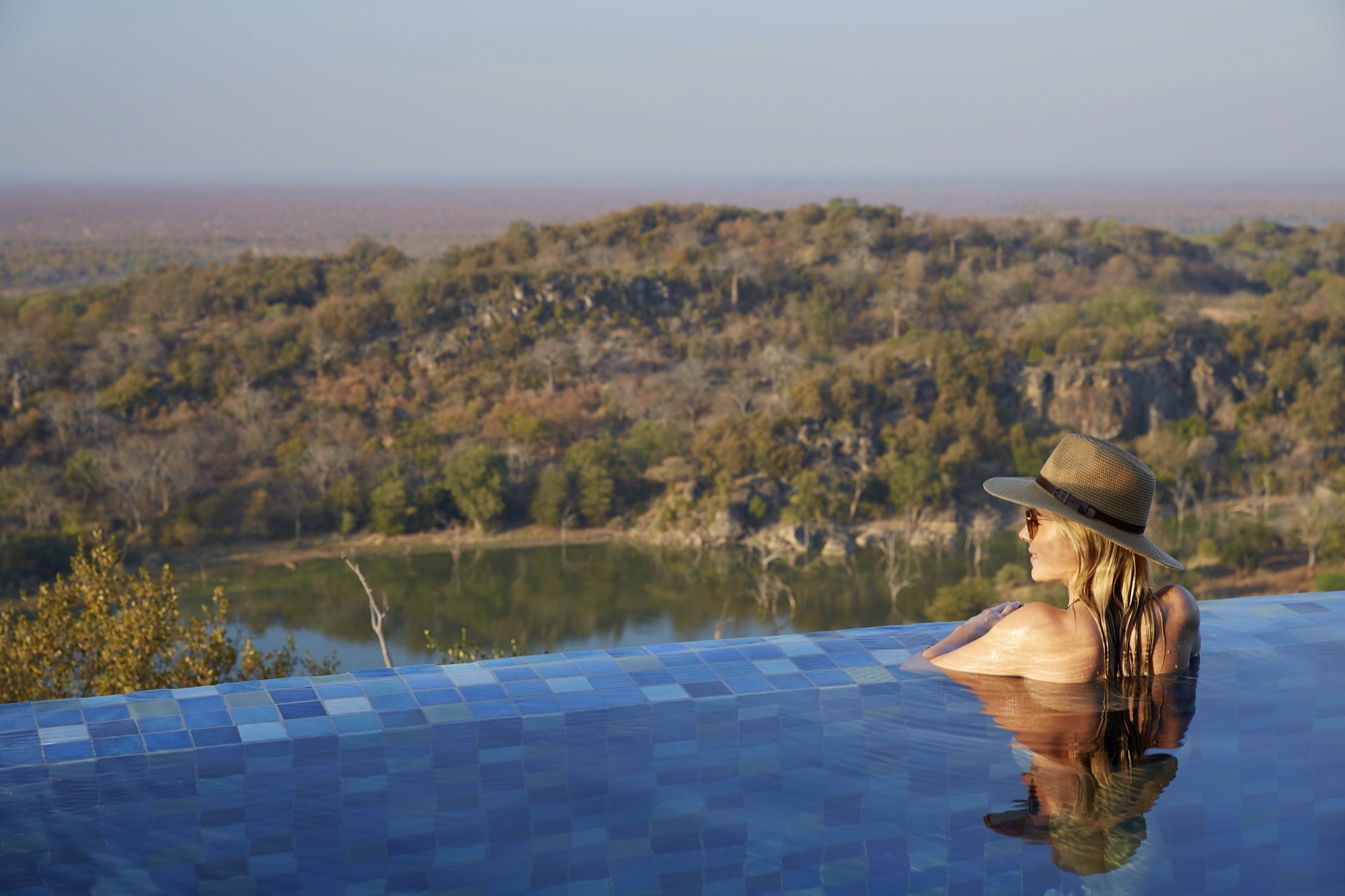
We have stayed here ourselves, and it remains one of the finest family houses in Africa. Malilangwe House is an exclusive-use home of five bedrooms, each with its own deck, around an interactive kitchen and a large rim-flow pool above the Malilangwe Dam, with a private chef, field guide, butler and vehicle. Children of all ages are welcome, and activities are shaped around each family: game drives, boat cruises, fishing and excursions to ancient rock art, with a Mini Rangers course for younger guests and guided walks from sixteen.
The reserve behind the house, 115,000 acres bordering Gonarezhou National Park, is a conservation story children can follow. The Malilangwe Trust introduced 28 black and 15 white rhinos in 1998. Today the reserve holds a globally significant population of both and supplies rhinos to restock reserves elsewhere in Africa.
All of Zimbabwe sits in CDC's malaria zone, and the house is remote by design. Children join game drives at the field guide's discretion. For families who would rather avoid prophylaxis, the Eastern Cape does much of the same job without it.

When the Children Are Teenagers
The Okavango comes into its own once children reach twelve, the age Wilderness sets for walking safaris at its Botswana camps. At Wilderness Vumbura Plains children are welcome, with children's menus and a Bush Buddy for six- to twelve-year-olds, but families with young children book a private guide and vehicle. For a teenager, a morning poled through papyrus channels by mokoro breaks the rhythm of the drive in exactly the right way. Water activities depend on flood levels, so the month matters as much as the camp; the seasonal picture is in Best Time to Go on Safari.
Fifteen opens the gorillas. Rwanda, Uganda and the DRC all set the minimum age for gorilla trekking at fifteen. At Singita Kwitonda, the four-bedroom Kataza House lets a mixed-age family stay together while only those fifteen and over trek, with childminders for the younger children. Kwitonda is one of the gorilla stays in our Rwanda & Tanzania itinerary.

Close Calls
Singita's Sabi Sand lodges were the hardest to leave off. Ebony welcomes children of all ages, with the free private vehicle for families of four or more with a child under ten. Castleton, the exclusive-use house, includes one vehicle for up to eight guests and two for nine to twelve. They sit here only because we gave the Sabi Sand one place among the ten, and Londolozi's approach to children took it. For a family with a four-year-old, too young for Varty or Founders, either may be the better call.
Also in the Sabi Sand, Cheetah Plains welcomes all ages and offers three exclusive-use four-bedroom villas, each with its own electric Land Cruiser. In Thornybush, Royal Malewane takes children over ten in its main lodge's Luxury Suites, and children of any age in its Royal Suites, Africa House and the Farmhouse.
In the Eastern Cape's Great Karoo, Samara Karoo Reserve came close: malaria-free, open to all ages at Karoo Lodge and The Manor, never more than 40 guests across 67,000 acres, a private vehicle included with its two family suites on stays of three nights or more, and The Manor, booked whole for up to eight, with its own vehicle, guide, tracker, chef and host. Children under eight skip the shared game drives for shorter bumble drives, which is where that private vehicle earns its keep. It stays a close call because it has held the Big Five only since 2019 and, by Samara's own account, its leopard are seldom seen.
In Kenya, Angama Mara takes all ages year-round and keeps interconnected suites in each camp. In standard season the first two children stay free, June and October excepted. Cottar's took the Mara place on conservancy freedom; Angama is often the better value.
In Laikipia, Ol Jogi is the close call for a family that wants a private world: one party at a time, children of all ages, and a 58,000-acre conservancy run as a private rhino sanctuary, with a veterinary clinic, a wildlife rescue center and orphaned rhinos to visit in their bomas. It sits here for its price: it is among the most expensive stays in Africa, priced per person on a sliding scale that falls as the party grows. And although it calls itself malaria-free, at roughly 1,800 to 2,200 meters the estate lies inside CDC's malaria zone, so it offers families no malaria advantage over the Mara. For a large party already set on Kenya, it is still worth the conversation.
In Namibia, &Beyond Sossusvlei Desert Lodge is the wild card, and the rare place where children look up more than out. Its 31,400-acre private reserve lies beside Africa's first International Dark Sky Reserve, a visiting astronomer leads stargazing at its observatory on select evenings, and CDC advises no antimalarials there. It is not a Big Five destination and doesn't pretend to be. The suites set tight terms: a standard suite takes only one child with the parents, and the Star Dune Suite two, or three on request. Under-eights stay off the lodge's scheduled activities. Families with children eight and over who would rather have dunes, light and silence than the Big Five should keep it on the shortlist. More in our Namibia safari guide.

Family Safari Lodge Questions, Answered
Which luxury safari lodges welcome children of all ages?
Nine of the ten here do, in at least some of their accommodation. The exception is Londolozi, where children must be six. At Phinda, under-sixes join game drives only with a private vehicle; at Shamwari, children under three stay off game drives, even in a private vehicle; and at Marataba, Mountain Lodge takes no one under sixteen, so families with younger children stay at Safari Lodge or the Villa.
What is the best malaria-free safari for young children?
For the Big Five, Kwandwe in the Eastern Cape, whose private vehicle suites take children of any age on game drives. For a house of your own, Morukuru Family in Madikwe. Marataba, a few hours from Johannesburg in the very low-risk Waterberg, takes all ages on drives at Safari Lodge and the Villa. Tswalu Kalahari has no elephants, but every booking includes a private vehicle, guide and tracker, so a toddler can join the drive and leave it early.
Do we need a private vehicle with young children?
Below six, almost always. The question is who pays. Tswalu includes one with every booking, and Singita Ebony does for families of four or more with a child under ten. Exclusive-use houses include one with the house. Elsewhere it is a daily supplement worth pricing before anything else.
What is the best age for a family safari?
Any age can work at the right lodge. Eight to twelve is when safari tends to leave the deepest mark. Twelve opens walking safaris at many camps, including Wilderness's in Botswana, and fifteen opens gorilla trekking.
Are safari lodges safe for small children?
Yes, at the right property with the rules followed. Some are fenced: Kwandwe's Ecca Lodge is fully fenced, and so are Morukuru's houses. Many camps are not, so a guide walks everyone to their room after dark. With toddlers, ask about pool nets and childminding before you book.
Which safari lodges are best for multi-generational families?
The ones with a house to take. Kwandwe's three villas, Morukuru's houses, Sarili at Shamwari, Marataba Villa, Tarkuni at Tswalu, Phinda Homestead, Cottar's Bush Villa, Serengeti House and Milele at Grumeti, and Singita Malilangwe House all come with their own guide and vehicle, so each generation can have its own morning.
How far ahead should families book?
Twelve to eighteen months for school-vacation dates, because most lodges have only a few family suites or interconnecting rooms, and they go first.

How This List Was Made
We weighted this list toward families with a wide spread of ages, because that is who we most often plan for. Each property was judged first on whether its youngest guests can join a game drive. Then came malaria, family rooms and houses, children's programming, fencing, how far its activities stretch from toddler to grandparent, and access. Luxury was the entry requirement, not the tiebreaker. Five of the ten sit in South African reserves where CDC advises no antimalarials, and four of those also hold the Big Five, the pairing that spares a young family both the prophylaxis conversation and a missing elephant. The rest are there for what they add: Phinda's range from bush to coast, the Serengeti, the Mara and a house of your own in Zimbabwe, while Londolozi, the one entry that asks children to be six, stands as the benchmark for the school-age years. Botswana and Rwanda wait with the teenagers, because walking safaris open at twelve and gorilla trekking at fifteen. No lodge paid to be included.
Age policies reflect each property's published terms as of September 2026, and malaria notes follow CDC guidance. Policies change, so we confirm every one again before it reaches a proposal.

Who's Coming?
Every family safari we design begins with the same few questions. How old is the youngest? How does the oldest like to spend a morning? And what would make this the trip they describe to their own children one day? The answers choose the lodge more reliably than any list, this one included. Tell us who's coming, and we'll tell you where they belong.
The Printable Safari Packing Checklist
Four designed pages, free: the complete checklist, the landscape palette, packing by season, and traveling with children. Tell us where to send it.
Read Further



Ready to Plan for Every Age?
The right lodge depends on the youngest traveler, the oldest one's mornings and everyone in between.
Tell us the ages and the dates, and we'll match them to the camps that fit.

" height="6.799809999999999px" id="UnPIFpqy2" transform="translate(4.733 4.667)" width="6.799800000000001px"/><path d="M 0.8 0 C 1.267 0 1.6 0.4 1.6 0.8 C 1.6 1.267 1.266 1.6 0.8 1.6 C 0.333 1.6 0 1.267 0 0.8 C 0 0.334 0.333 0 0.8 0 Z" fill="rgb(165, 176, 170)" height="1.6000999999999999px" id="wjKJl84P4" transform="translate(10.867 3.733)" width="1.6000999999999994px"/><path d="M 7.333 0 C 8.533 0 8.8 0.067 9.4 0.067 C 10.467 0.134 11.466 0.4 12.2 1.133 C 12.933 1.867 13.2 2.867 13.267 3.934 C 13.333 4.533 13.333 4.8 13.333 6 L 13.333 7.333 C 13.333 8.533 13.267 8.8 13.267 9.4 C 13.2 10.467 12.933 11.467 12.2 12.2 C 11.466 12.933 10.467 13.2 9.4 13.267 C 8.8 13.333 8.533 13.334 7.333 13.334 L 6 13.334 C 4.8 13.334 4.533 13.267 3.933 13.267 C 2.8 13.2 1.867 12.933 1.133 12.2 C 0.4 11.467 0.133 10.467 0.066 9.4 C 0 8.8 0 8.533 0 7.333 L 0 5.934 C 0 4.734 0.066 4.467 0.066 3.867 C 0.066 2.8 0.333 1.867 1.133 1.067 C 1.867 0.334 2.8 0.067 3.866 0.067 C 4.466 0 4.733 0 5.933 0 Z M 6.666 1.2 C 4.933 1.2 4.733 1.267 4 1.267 C 3.266 1.333 2.533 1.467 2 2 C 1.466 2.533 1.333 3.267 1.267 4 C 1.2 4.667 1.2 4.867 1.2 6.667 C 1.2 8.4 1.2 8.6 1.267 9.333 C 1.333 10.067 1.466 10.8 2 11.333 C 2.533 11.867 3.266 12 4 12.067 C 4.666 12.134 4.866 12.133 6.666 12.133 C 8.4 12.133 8.6 12.067 9.333 12.067 C 10.066 12 10.8 11.867 11.333 11.333 C 11.866 10.8 12 10.067 12.066 9.333 C 12.133 8.6 12.133 8.4 12.133 6.667 C 12.133 4.934 12.066 4.733 12.066 4 C 12 3.267 11.866 2.533 11.333 2 C 10.8 1.467 10.066 1.333 9.333 1.267 C 8.666 1.2 8.466 1.2 6.666 1.2 Z" fill="rgb(165, 176, 170)" height="13.3335px" id="W1sWTdVhE" transform="translate(1.467 1.467)" width="13.33300001940264px"/></svg>)
" height="12.000010000000001px" id="Px7drxAPR" transform="translate(4.133 2.134)" width="7.53329px"/></svg>)
" height="13px" id="RXaPy7s6t" transform="translate(0.838 1.5)" width="14.381208999999998px"/></svg>)
" height="11.99998861028647px" id="xgm2Ladnt" transform="translate(2.036 2)" width="11.92787px"/></svg>)
" height="9.26662px" id="tz2Esvrs4" transform="translate(1.467 3.567)" width="13.333300000000001px"/></svg>)